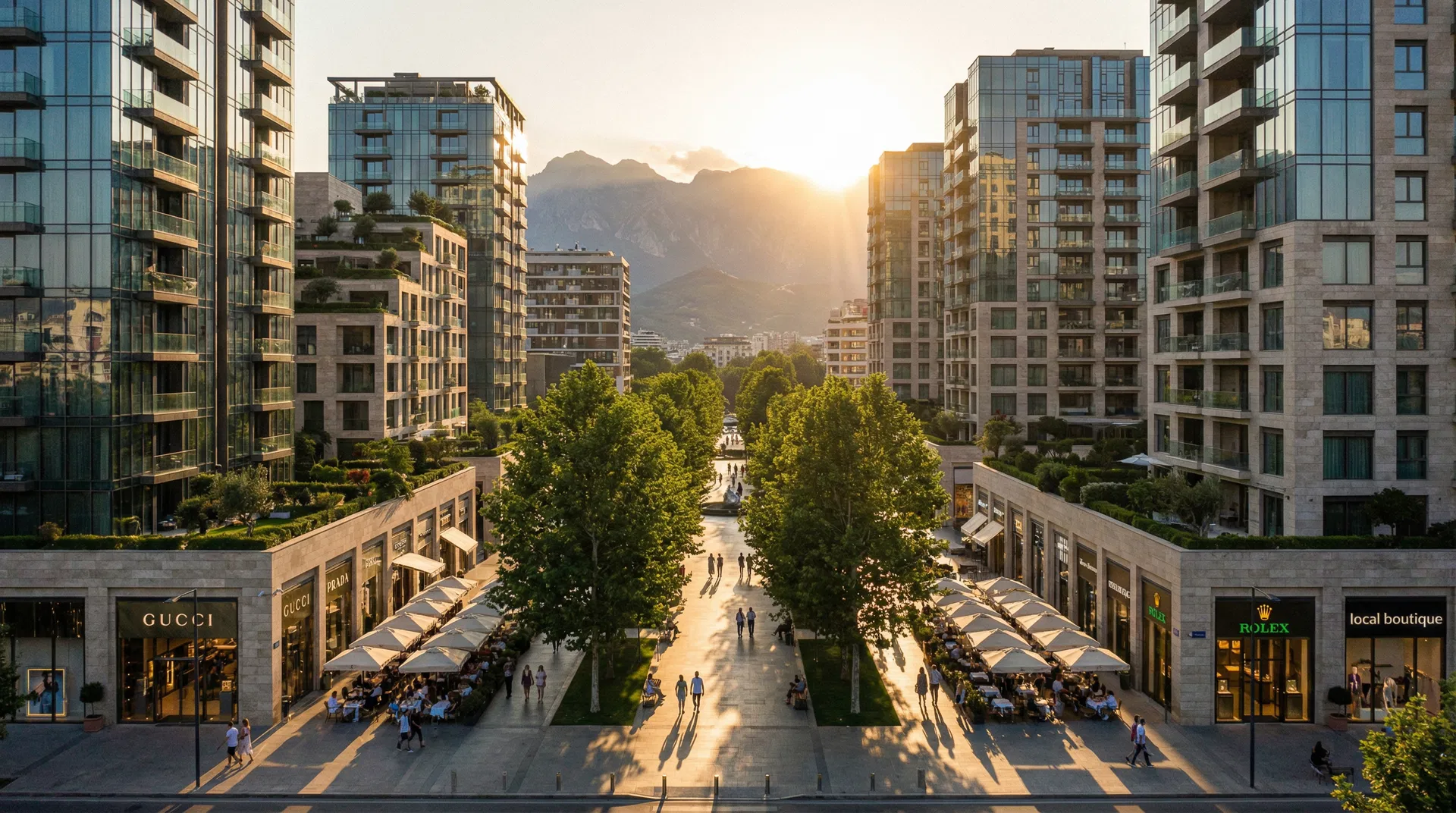
Some locations sell square meters. Others sell time. Boulevard I Ri belongs to the second category. A data-driven investment guide with real macroeconomic figures.
Some locations sell square meters. Others sell time. Boulevard I Ri belongs to the second category.
This is not just a street in a growing capital. It is part of Tirana's next chapter — a corridor where modern planning, premium development, visibility, and long-term city relevance meet. For buyers looking beyond today's brochure and thinking like investors, that matters far more than hype.
If you are exploring Boulevard I Ri property investment, looking to buy investment property in Tirana centre, or studying Albania real estate investment in 2026, this guide explains why Boulevard I Ri stands out, what the current data says, how foreign investors can buy, and what you should think through before committing capital.
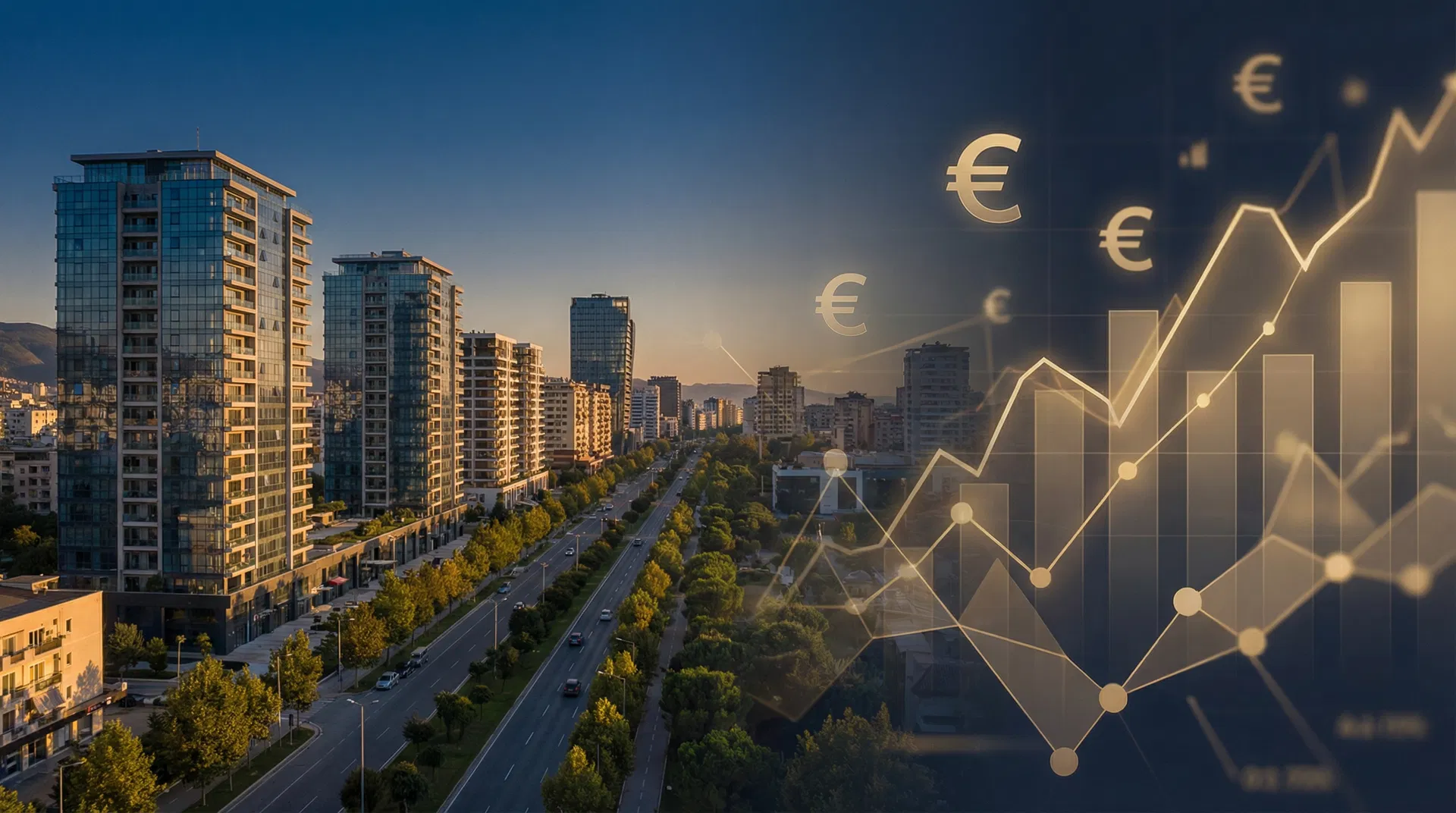
Why Boulevard I Ri Stands Out for Investors
In real estate, the best investments are rarely random. They tend to sit where infrastructure, identity, and future demand begin to overlap.
Boulevard I Ri is increasingly attractive for that reason. The numbers tell a compelling story: Albania's GDP grew by 4.0% in 2024 and 3.8% in 2025, making it one of the highest growth rates in Europe according to the IMF. The World Bank projects continued growth of 3.5% in 2026, supported by domestic demand and solid investment flows.
Tirana's broader property market has shown strong momentum: Deloitte's 2025 Property Index reported that new apartment prices in Tirana rose 25% year on year, among the sharpest increases in the region. Meanwhile, the average apartment price across Albania reached €1,620 per square meter in 2024 — a 16.6% increase that ranked as the second highest growth rate in all of Europe. By June 2025, the Keydata Index showed Tirana's average had climbed further to €1,830 per square meter.
Colliers' 2024 Market Overview confirmed that Albania's real estate market is making a growing contribution to GDP, with strong performance across residential, hospitality, office, and retail sectors.
That does not mean every property will perform equally well. In fact, Bank of Albania research flagged that house prices in mid-2025 were at least 5% above their “normal” levels, which is a useful reminder that strong markets still require selectivity. Smart investors should read Boulevard I Ri as a premium micro-location inside a broader rising market — not as a reason to suspend discipline.
Albania's Macroeconomic Foundation: The Numbers That Matter
Before investing in any property market, sophisticated investors look at the macroeconomic fundamentals. Albania's numbers are increasingly hard to ignore.
GDP and Economic Growth
Albania's economy has been on a sustained upward trajectory. With GDP reaching approximately $25 billion in 2024 (IMF estimate), the country has achieved consistent growth rates that outpace most of Europe:
2022: 4.8% GDP growth
2023: 4.0% GDP growth
2024: 4.0% GDP growth
2025: 3.8% GDP growth (actual)
2026: 3.5% projected (World Bank)
The IMF's December 2025 Article IV Consultation concluded that “Albania enjoys one of the highest growth rates in Europe, low inflation, declining public debt, and strong foreign reserves.” That is not promotional language — it is the IMF's official assessment.
Foreign Direct Investment: Record Inflows
Foreign capital is flowing into Albania at unprecedented levels. FDI reached a record €1.58 billion in 2024, a 5.6% increase over 2023. To put that in perspective, FDI has nearly doubled from €0.9 billion in 2020 to €1.6 billion in 2024.
The trend continued into 2025: FDI inflows in the first nine months of 2025 reached €449 million, up 10% year-on-year according to Albania's official statistics agency. US investment stock in Albania alone grew from $300 million to $382 million between 2023 and 2024.
This is not speculative capital. It reflects growing institutional confidence in Albania's economic trajectory, legal framework, and strategic position.
Tourism: A 12.5 Million Visitor Economy
Albania's tourism sector has become a major economic engine. The country welcomed a record 12.47 million foreign visitors in 2025, a 6.6% increase over the 11.7 million recorded in 2024. Even more striking: overnight stays by foreign visitors surged 37.9% to 7.14 million in 2025.
Tourism now contributes an estimated 25% or more to Albania's GDP, according to preliminary 2024 data. This matters for property investors because tourism drives demand for short-term rentals, hospitality-adjacent real estate, and premium urban addresses like Boulevard I Ri where visitors increasingly seek modern, well-located accommodation.
Why Many Investors See Boulevard I Ri as Albania's #1 Urban Address
The investment case for Boulevard I Ri is not only about centrality. It is about concentration.
This corridor brings together several of the ingredients investors usually want in one place: new stock, better urban planning, stronger visual identity, easier marketability, and a buyer pool that includes locals upgrading, diaspora capital, and foreign buyers watching Tirana's next premium districts take shape.
In practical terms, Boulevard I Ri tends to appeal to investors who care about one or more of the following: capital appreciation, prestige positioning, liquidity on resale, rental appeal, or long-term portfolio quality.
Property Appreciation: What the Data Says
The hard data points worth knowing:
Deloitte Property Index 2025: New apartment prices in Tirana rose 25% year-on-year — among the sharpest increases in the region
National average: Albania's apartment prices reached €1,620/sqm in 2024, up 16.6% YoY — the second highest growth rate in Europe
Tirana premium: By June 2025, Tirana's average reached €1,830/sqm (Keydata Index)
20-year trend: Apartment prices in Tirana have tripled over the past two decades
Bank of Albania caution: Prices were at least 5% above “normal” levels by mid-2025
So what does that mean for Boulevard I Ri? A reasonable inference is that premium, visible, newer corridors like Boulevard I Ri are better positioned than average stock if Tirana continues to attract capital and demand. But the word is “positioned,” not “guaranteed.” Future upside will likely depend on entry price, developer quality, layout efficiency, completion risk, and whether the wider market keeps absorbing supply.
Rental Yield Potential: Residential and Commercial
The strongest investment pages are honest: yield is never just “the market yield.” It is the yield of a specific asset, bought at a specific price, managed in a specific way.
For residential property on Boulevard I Ri, the attraction is usually a combination of modern stock, stronger tenant appeal, and broader resale liquidity. With 12.5 million tourists visiting Albania annually and a growing expat community, rental demand in premium Tirana locations continues to strengthen.
For commercial property, the upside can be stronger when the unit has the right frontage, tenant covenant, lease structure, and footfall — but the risk can also be more concentrated.
What is easier to verify is the tax framework that affects net returns. PwC's 2026 Albania summary says annual building tax is 0.05% of value for residential property and 0.2% for commercial property, and capital gains on the transfer of real estate are taxed at 15% of the gain. Those are not your only costs, but they are part of any serious net-yield model.
Why EU Accession Matters for Boulevard I Ri Values
This is where international investors usually pay closer attention.
Albania's EU accession process accelerated dramatically in 2025. The country opened all six negotiation clusters within just over a year — an unprecedented pace:
December 2024: Cluster 6 — External Relations
April 2025: Cluster 2 — Internal Market
September 2025: Cluster 4 — Green Agenda and Sustainable Connectivity
November 2025: Cluster 5 — Resources, Agriculture and Cohesion
Albania's target is to close all negotiation chapters by the end of 2027. The European Parliament noted in March 2026 that Albania has an “ambitious objective” of concluding accession negotiations by that date, though it remains tied to continued reforms.
What could that mean for property values? Not a magic price jump. A better way to think about it is that credible EU progress reduces perceived country risk over time, improves legal and institutional confidence, attracts more international attention, and supports broader economic convergence. For Boulevard I Ri, that matters because premium urban locations usually benefit first when international confidence improves.
Albania's Framework for Foreign Investors
For foreign buyers, Albania remains relatively open by regional standards. AIDA (Albanian Investment Development Agency) states that 100% foreign ownership is possible and that foreign investors are entitled to repatriate funds and in-kind contributions. There are no restrictions on foreigners acquiring residential units such as apartments and offices, while agricultural land follows different rules.
For many international buyers, that combination matters: accessible ownership, relatively low recurring property tax (0.05% annually for residential), and a growth story linked to both Tirana's urban expansion and Albania's wider economic convergence.
How to Buy as a Foreign Investor
Buying in Albania is not difficult, but it should be done carefully.
Define your strategy — Are you buying for long-term capital appreciation, rental income, partial personal use, or future resale?
Choose the right asset, not just the right area — Boulevard I Ri is a location thesis. The actual investment decision still depends on the specific apartment: floorplan, floor, exposure, views, parking, building quality, and developer reputation.
Verify the developer and project documentation — Check ownership, permit status, project stage, delivery timeline, technical specification, and contract structure.
Review the legal and tax position — At minimum, understand title, payment schedule, annual property tax, transfer tax treatment, capital gains treatment on exit, and whether any VAT issues arise.
Reserve, contract, and register — Once due diligence is complete, buyers typically reserve the asset, sign contract documents, complete payments, and finalize transfer through the notarial process.
What Sophisticated Investors Should Focus On
A premium address alone is not enough. The strongest buyers usually look at five things:
Entry price discipline: Even a great boulevard can produce mediocre returns if you overpay
Developer quality: Execution risk matters — USLUGA's 30+ years of experience in Albanian construction provides the kind of track record serious investors look for
Asset liquidity: Some units are easier to resell than others
Income durability: The wrong commercial tenant mix or weak residential layout can hurt yield
Macro timing: Strong momentum is helpful, but markets rarely move in straight lines
That balanced view is especially important now, because the market has both positive drivers (GDP growth, record FDI, EU accession momentum) and valuation risk signals (Bank of Albania's 5% overvaluation flag) at the same time.
The Investment Case in Numbers
Here is a summary of the key macroeconomic indicators that underpin the Boulevard I Ri investment thesis:
GDP Growth: 3.8–4.0% annually (2024–2025), among Europe's highest
FDI: €1.58 billion record in 2024, +10% in first 9 months of 2025
Tourism: 12.47 million visitors in 2025 (+6.6%), overnight stays +37.9%
Property Prices: +25% YoY for new apartments in Tirana (Deloitte 2025)
EU Accession: All 6 negotiation clusters opened, target 2027 completion
Tax: 0.05% annual building tax (residential), 15% capital gains
Foreign Ownership: 100% permitted, no restrictions on apartments/offices
IMF Assessment: “One of the highest growth rates in Europe”
Frequently Asked Investor Questions
Is Boulevard I Ri a good place to invest in Tirana?
It is one of the more compelling premium-growth corridors in Tirana, especially for buyers who want newer stock, stronger visibility, and a location tied to the city's future development.
Is Albania open to foreign real estate investors?
Broadly yes. AIDA says 100% foreign ownership is possible, and its investment guide states there are no restrictions on foreigners buying residential units such as apartments and offices.
Does EU accession really matter for property values?
It can matter indirectly by improving confidence, reform alignment, and institutional credibility. Albania opened all six negotiation clusters by end 2025 and targets completion by 2027. But price appreciation is never automatic.
What taxes should investors model?
At a minimum: annual building tax (0.05% residential, 0.2% commercial), transaction-related costs, and capital gains tax on exit (15% of the gain).
Is the market still rising?
Recent data has been strong — 25% price growth for new apartments in Tirana (Deloitte 2025). But Bank of Albania research also suggests prices were above “normal” levels by mid-2025. Buyers should stay selective.
Final Thoughts
The best investment addresses are rarely attractive for only one reason.
Boulevard I Ri works because several stories are happening at once: Tirana is modernizing with 3.8% GDP growth, Albania attracted a record €1.58 billion in FDI in 2024, the country welcomed 12.5 million tourists in 2025, property prices have risen 25% year-on-year, and the EU accession process has accelerated to an unprecedented pace with all negotiation clusters now open.
At the same time, the smartest investors will remember that a rising market still rewards discipline, underwriting, and patience. The data supports optimism. The opportunity is real. But the best returns will go to those who combine conviction with careful execution.
Fjalë Kyçe